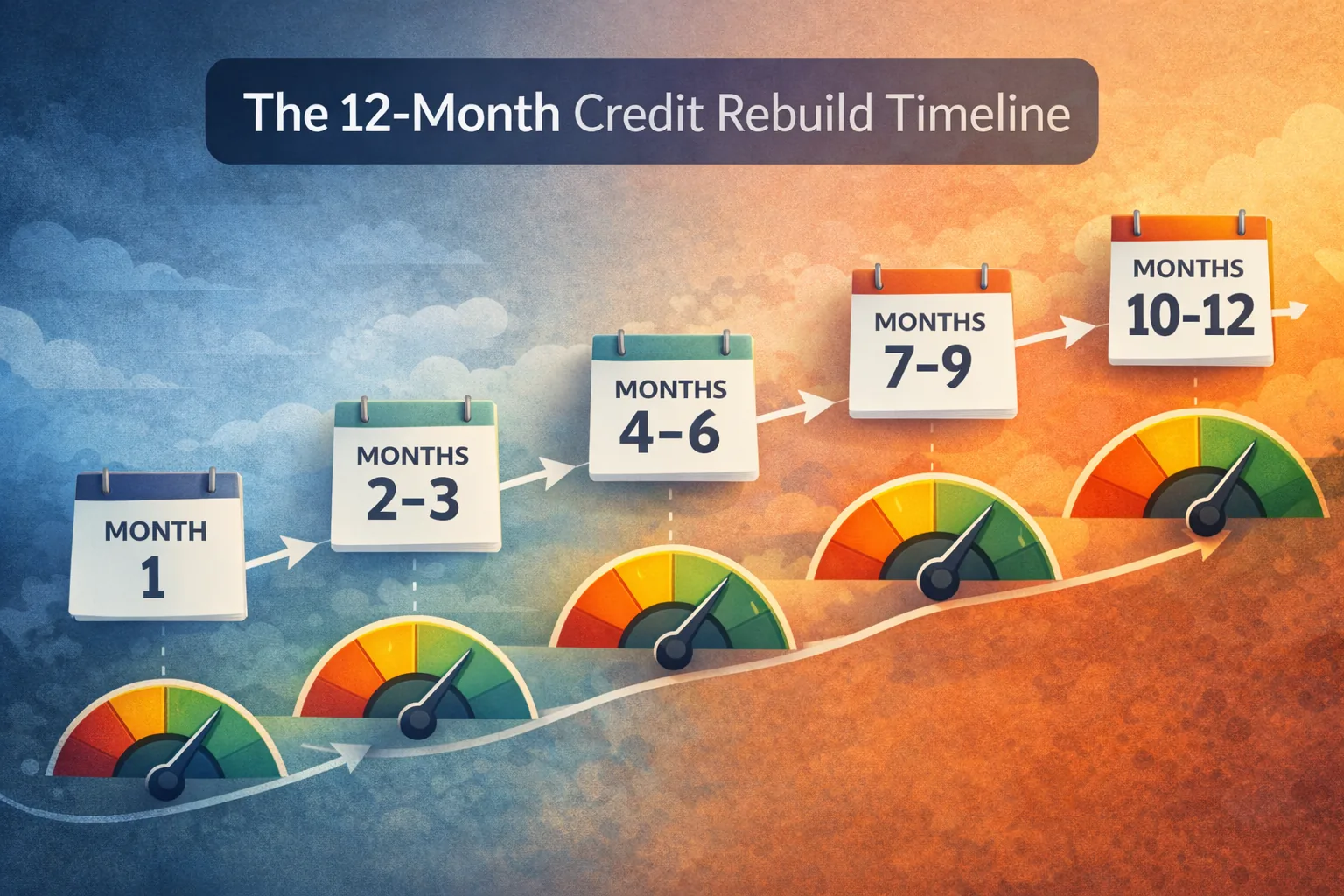
The 12-Month Credit Rebuild Timeline: What Actually Happens to Your Score
Rebuilding credit is not a straight line. Here is what typically happens month by month, why the plateaus are normal, and what to do to keep your score moving.
The Promise vs Reality
Every credit rebuilding guide promises a miracle: “Add 100 points to your score in 12 months.”
Here is what they do not show: the boring, frustrating, sometimes satisfying timeline of real score recovery.
Month 1: You Open a New Tradeline
What you do: Apply for a secured card or a credit builder loan.
What happens to your score: It can dip from a hard inquiry and a new account lowering average age. A small drop is normal.
How you feel: Annoyed. You are trying to build credit and it just went down.
Reality check: The inquiry impact fades over time. The new account becomes a net positive once you build clean payment history.
Months 2 to 3: The First Reporting Cycle
What you do: Make your first on time payments. Keep utilization low.
What happens to your score: You might see little movement. Sometimes you get a small bump. Sometimes nothing.
How you feel: Impatient. You are doing everything right and seeing no results.
Reality check: Credit scoring needs repeated data points. Early months are foundation work.
Months 4 to 6: The First Meaningful Lift
What you do: Continue on time payments. Keep utilization under 30 percent, ideally under 10 percent.
What happens to your score: This is where many people see the first noticeable increase. The size depends on what else is in your report.
How you feel: Validated. It is actually working.
Reality check: This is where people sabotage progress by applying for more credit. Do not.
Months 7 to 9: The Plateau Phase
What you do: Same routine. On time payments. Low utilization.
What happens to your score: Often not much. Maybe a small increase. Sometimes flat.
How you feel: Irritated. You are doing everything right and the score is not moving.
Reality check: Plateaus are normal. The score is not dropping, and your payment history is getting thicker. Boring is good.
Months 10 to 12: The Compound Effect
What you do: Keep the routine. Most people have payments automated by now.
What happens to your score: Many people see another bump as they cross a year of clean activity. Some secured cards review for graduation.
How you feel: Relieved. A little proud.
Reality check: A full year of clean payments is a big signal. Negative marks are also older, which usually reduces their impact.
What a 12 Month Credit Reset Usually Looks Like
Score changes are not linear.
But the pattern is consistent.
What Actually Moves the Score
Most people overcomplicate this.
These are the levers that matter:
Bottom Line
Rebuilding credit is boring on purpose.
You are not going to hack it.
You are going to make 12 consecutive on time payments on a card you can control, keep utilization low, and your score will rise over time.
If you want to start with the right card and the right approach, take our Financial Reset Assessment. It takes 2 minutes and gives you a recommendation based on your situation.
FAQ: 12 Month Credit Rebuild Timeline
Why did my score drop when I started rebuilding
Hard inquiries, a new account lowering average age, and changes in utilization can cause a small early dip.
When will I see the first score increase
Many people see movement between months 3 and 6, but it varies based on what is already on the report.
What is the fastest way to rebuild credit in 12 months
On time payments, very low utilization, and avoiding new credit applications are the simplest fastest path.
Do I need to carry a balance to rebuild
No. Paying in full is fine and avoids interest.
Related Card

Annual Fee
$0
APR
N/A (No interest charged)
Annual Fee
$0
APR
N/A (No interest charged)
Money Matters Editorial Team
Our editorial team consists of financial experts and credit specialists dedicated to providing honest, data-informed guidance for individuals rebuilding their credit. We review every card based on real-world utility, fee structures, and accessibility for those recovering from financial hardship.